
I thought it would be fun to turn my colour system and a bit of music theory into a personality quiz. However, I didn't want to weaken the system I'd built. If anything, I wanted to go deeper into it: to put more theoretical pillars in place, and to share the whole thing through something approachable.
I also wanted to chip away at some of the fear around Classical music, which can feel like such a closed, niche world. One of the reasons I first started translating music scores was so that I could study them properly. When I used to play piano, there was very little of that — I mostly concentrated on how the music felt.
My work is built on colour, and on the colour spectrum of the scale. The link to feelings, though, came later. It wasn't something I set out with. Once the system was already in place, I found myself wondering about it: colours have always carried meanings and symbolism, so what would it look like to explore that within my own work? The quiz grew out of that question.
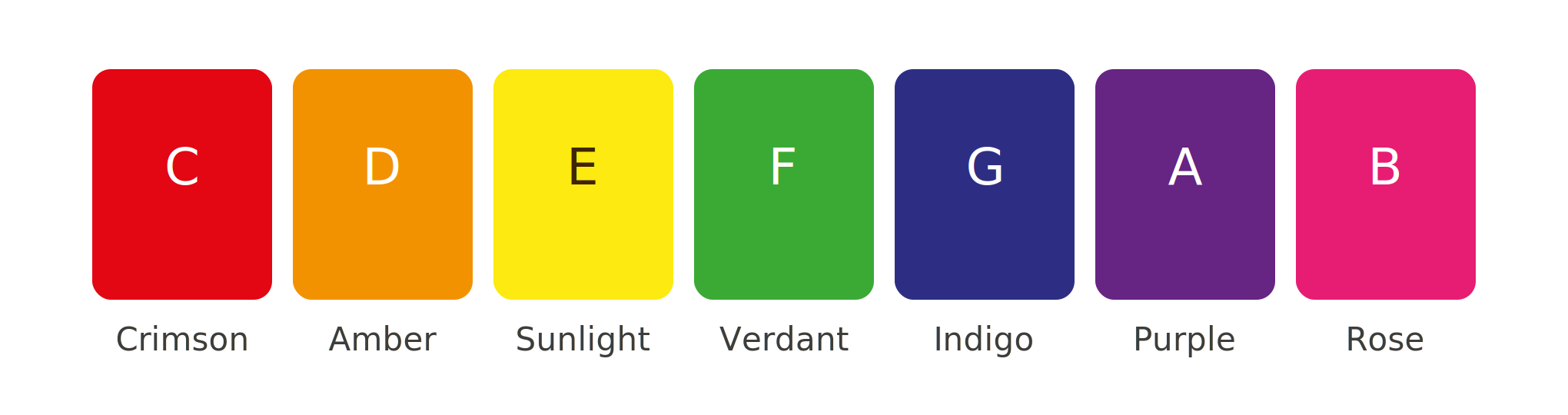
If you know my work, you'll know that every note is assigned its own colour, and that never changes (whichever key a piece of music happens to be in). My system has stayed fixed from the very beginning. It could change, but I've never wanted it to. I wanted a set rule, the way Western music has its tonal theory.
The cards
On 29 July I'm releasing a set of colour archetype cards, and making them has been its own kind of study.
Each card is built on a triad (simply meaning three notes). One side shows those three notes with their individual colours, and a short description of that interval's character. The other side is an artwork. It’s a visual representation of that particular archetype / personality. So each card holds both halves of what I’m doing here at once — the theory, and the feeling that comes out of it.
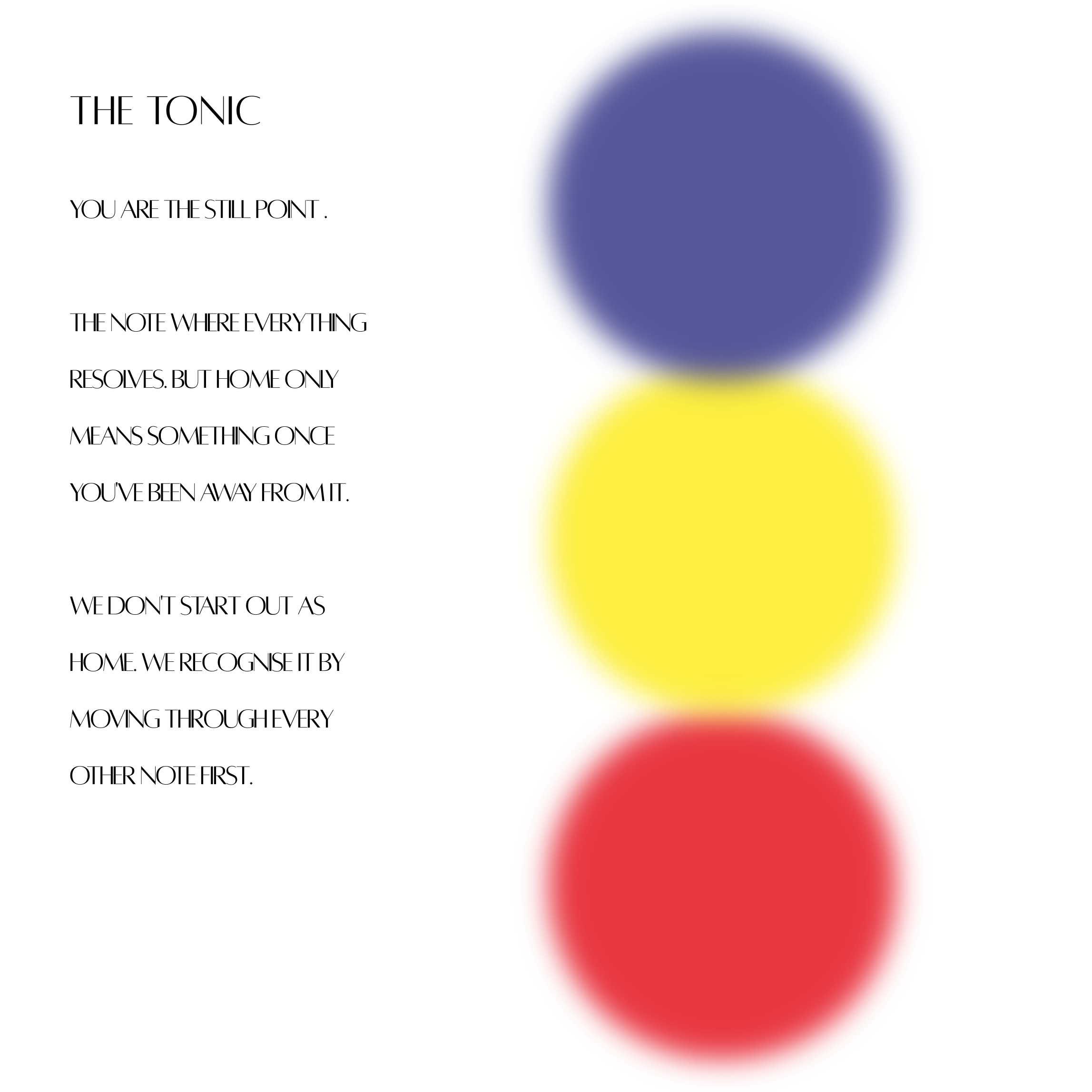

The Tonic in the key of C Major, where the tonic is C
This is the first of the cards and the intervals. The Tonic. It’s also considered ‘home’ — the still point the whole scale keeps returning to. And there's a reason it feels so right. The Tonic chord is built from the three primary colours — Crimson, Sunlight and Indigo, or red, yellow and blue — and from those three, every other colour can be mixed. So the home note doesn't only sit at the centre of everything…. it contains everything! The Tonic is the point of foundation.
In the Tonic's design, I wanted to show how all colours stem from its three triad colours, using a woven, Jacquard-like effect where the hues interlace and blend. As a result, you can see hints of orange, pink and purple threaded through the Tonic.
Something I didn't plan
As I was making these cards, I noticed something I hadn't planned. When I laid the colours out next to each other, a lot of the notes and their fifths turned out to be colour opposites — complementaries (colours that sit opposite each other on the wheel).
I didn't set out to make it work that way. It just happened, which is what surprised me.
Interestingly, it doesn't line up perfectly every time, and there's a reason for that. A normal colour wheel has six colours, each with a perfect opposite.
See the diagram below.
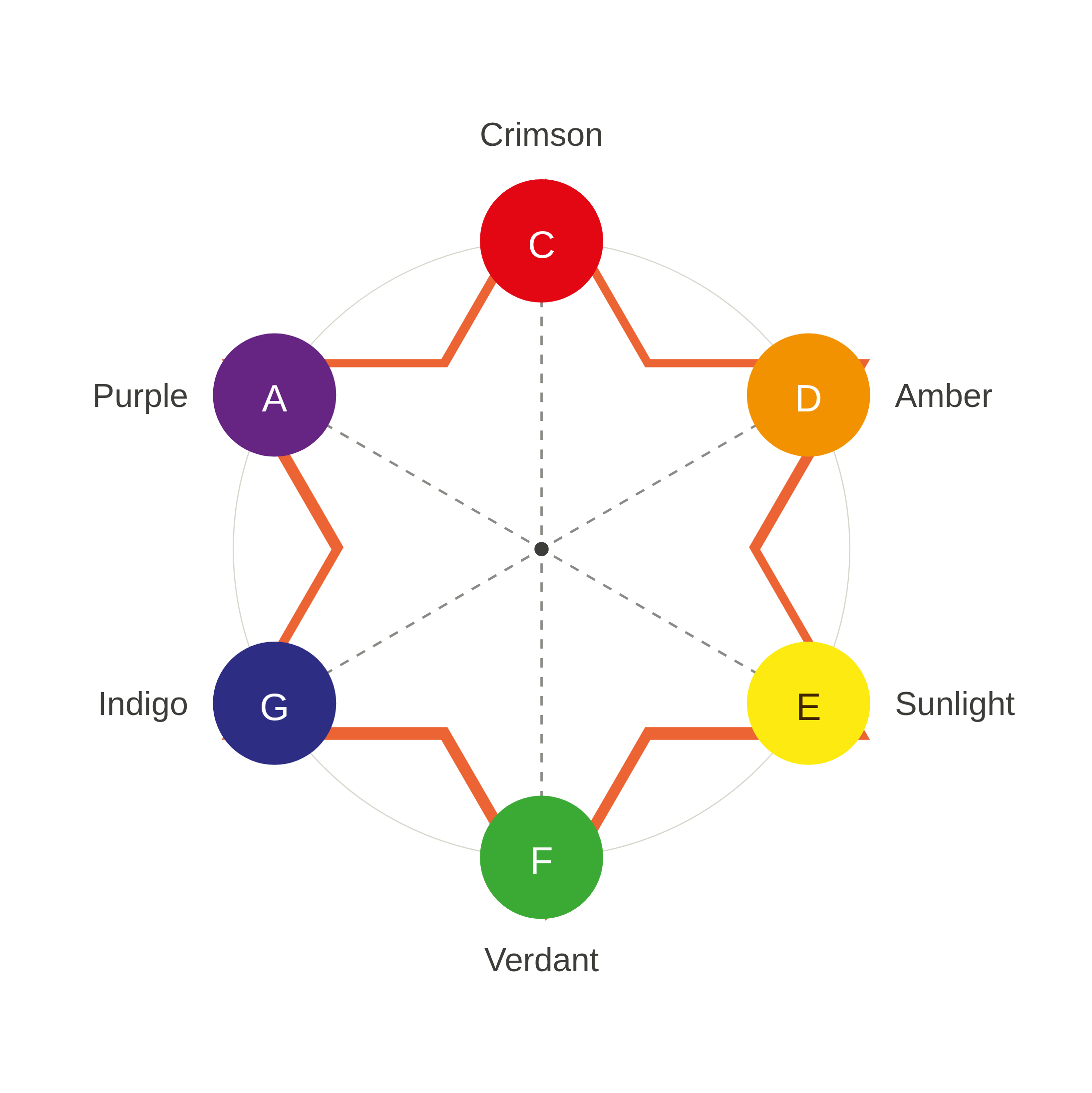
But my scale has seven. So the colours don't sit evenly around the wheel. There's always one that overreaches by a note. That's why it works cleanly one way (going down a fifth, like F back to C) and just overshoots the other (going up, like C to G):
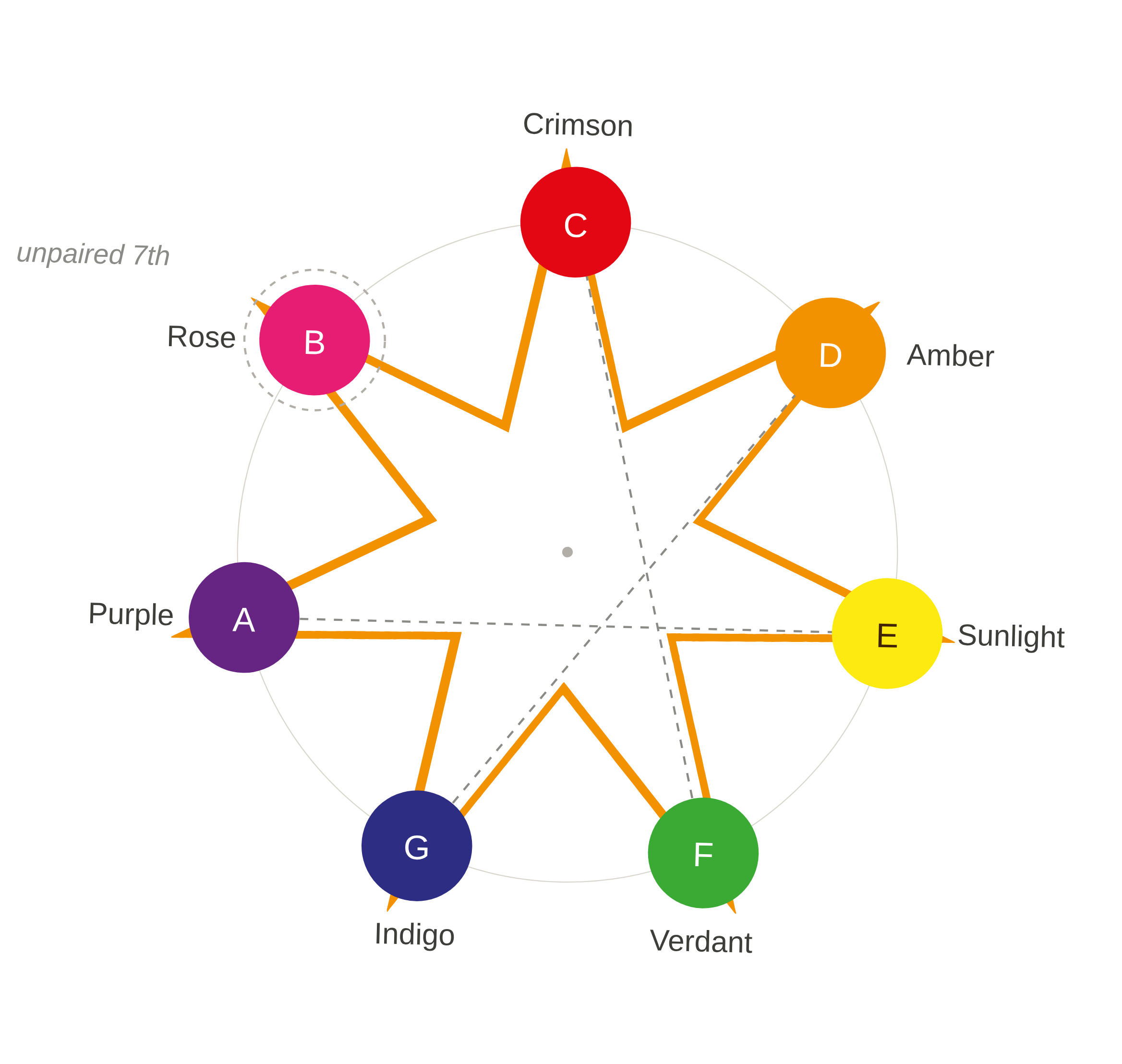
For me, that near-miss is the interesting part. I didn't force the system into place. It's built on real relationships between the notes, and the colours simply followed. That's what tells me there's something solid underneath — not just a pretty idea, but one that holds together.
The cards are coming
There's a lot of colour in my work, and a lot of brightness, but none of it is arbitrary. Every colour is where it is for a reason, and always has been. That's the whole point: not fanciful, but intentional. Coherent. Built to hold.
So which note are you?Take the colour archetype quiz to find out. When you get your result, sign up and your full archetype description lands in your inbox right away, along with all seven to explore. Then, on 26 July, you'll be first to receive your complete set of Colour Archetype Cards and a printable poster of all seven — ahead of the public launch on the 29th.